The Media Notepad: Chicago Bears “announce” they’re moving to Hammond
Also: Planned iHeart/SiriusXM merger shelved; Scripps and DirecTV engage in TV’s latest feud
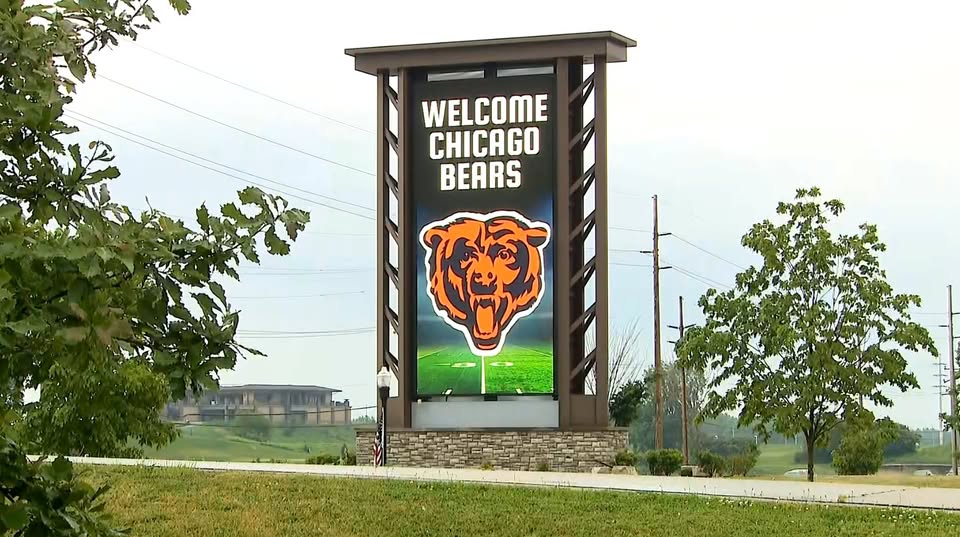
The stadium saga continues: The Chicago Bears announced Friday they are moving forward with a move to Hammond, Ind., right across the state line from Chicago – or so they say.
Despite being at Soldier Field for more than fifty years and the stadium being renovated in the early 2000s, the team stated the stadium is outdated and wanted to move to northwestern suburb of Arlington Heights, where they bought the former Arlington Race Track with intentions on building a new stadium on the site in 2021. But they are no closer to putting shovels into the ground now than they were five years ago as construction has been held up by property tax issues, school funding issues in the northwestern suburbs, and an Illinois General Assembly reluctant to give the McCaskeys public money for anything, as the “Megaprojects” bill stalled, failing to get a deal sone before May 31, when the governing body recesses for the summer. By comparison, Indiana swiftly put together a package deal for the Bears and passed easily by state government in Indianapolis.
Northwest Indiana – which consists of Lake, Porter, Newton, and Jasper counties, is in the nation’s third-largest market and has been part of “Chicagoland” since the first printing press was made. All reside in the Central Time Zone due to their close proximity to Chicago.
Illinois Governor J.B. Pritzker and Chicago mayor Brandon Johnson put out statements after the news were announced, saying a stadium bill “is still in play”, or something. Bears fans – especially those who live north of the Loop, were predictably outraged, and many criticized local and state leaders (something that would no doubt please President Trump as he’s ripped Pritzker and Johnson plenty since his return to the White House), and the team itself, which has really never had competent leadership in its history. On the other hand, some South Side, south suburban, and Northwest Indiana residents were thrilled with the news, and could help revitalize the area on both sides of the state line.
The Bears did not say where they would play in Indiana – meaning Hammond isn’t exactly a lock for landing the team. A site near Wolf Lake is being considered.
While this “announcement” has people talking, keep in mind the Bears haven’t signed any deal with Hammond officials and any new stadium being built is a ways off as the Bears have a lease at Soldier Field through 2033. The General Assembly could be called into a special session and a stadium bill still could be passed. So are the Bears moving to Indiana? Their feet seem to be pointing to that direction, but don’t count Illinois out, but as we all know in the wacky world of politics these days…anything can happen.
 The latest retransmission battle to take place is between DirecTV and Scripps, which pulled their local broadcast stations from both the satellite and streaming platforms on May 31. In all, 54 stations are affected, including WTMJ Milwaukee, WTVF Nashville, KSHB/KMCI Kansas City, and WXMI Grand Rapids, Mich. Not affected are Scripps’ Ion stations, which are part of an entirely different deal (this means you can still watch WCPX-TV through DirecTV.)
Scripps said this in the following statement:
Scripps has been engaging in good-faith negotiations with DirecTV to establish an equitable agreement that serves both companies and, most importantly, consumers. Regrettably, DirecTV has elected to remove Scripps local stations from their lineup, employing the same heavy-handed tactics that have become synonymous with pay-TV operators who hurt their own subscribers by using them as bargaining chips in contractual disputes. By contrast, Scripps stations have gone dark only twice since we began broadcasting in the 1940s.
Scripps remains committed to reaching a fair resolution that restores our local stations to DirecTV’s paying subscribers. At stake is our viewers’ fundamental access to trusted local journalism, critical weather alerts, emergency information and live sports programming that strengthens community bonds – all essential public interest content in which Scripps invests substantially every day.
Scripps recently was in a dispute with Comcast, which saw those same 54 stations leave the platform for the entire month of April.
DirecTV countered with this: Scripps is demanding the highest rates DIRECTV has ever received from a station group, which would continue to dramatically raise costs for consumers and businesses already struggling with affordability. After DIRECTV declined those demands and sought a more reasonable agreement, Scripps chose to remove its stations from viewers in several major markets nationwide. (You can read the full statement here.)
With the blackout, sports fans whose fans are DirecTV subscribers whose ABC affiliate is owned by Scripps are being shut out of the NBA Finals and the Stanley Cup Final, including the market where the Golden Knights play as KTNV Las Vegas is unavailable on DirecTV, as well as KNXV Phoenix, WEWS Cleveland, WCPO Cincinnati, WFTS Tampa, WXYZ Detroit, WMAR Baltimore, and eleven others.
 Six weeks ago, SiriusXM and iHeart Media were discussing a possible merger that would’ve created an audio giant to take on big tech. Now ot appears those talks have fizzled.
According to the New York Times, those talks have stalled as the two sides were not able to come to terms. The move was driven by the increasing demand for podcasts, as SiriusXM has Howard Stern and Alex Cooper’s Call Me Daddy (and curated music channel Unwell) while iHeart has The Breakfast Club, a live, top-rated nationally syndicated radio show targeted to Black audiences now streaming daily on Netflix. iHeart owns about 860 stations in the U.S., including seven here in Chicago, with one leased to Midway Broadcasting, owner of WVON-AM.
As you would’ve guessed, a SiriusXM-iHeart merger was widely criticized amid the current backlash stemming from the in-progress Paramount/Warner Bros. deal and a Nexstar-Tegna marriage, which is being held up by the courts despite the FCC hastily approving the deal.
Both have been down this road before: Clear Channel bought up several radio chains in the late 1990s and early 2000s, while Sirius and XM merged in 2008. At one time, Clear Channel stations openly mocked SiriusXM’s satellite pay-to-play model in numerous PSAs. Clear Channel changed its name to iHeartMedia in 2014 to emphasize online distribution and streaming, more so than the terrestrial stations it owns.
The growing threat of Big Tech companies like Spotify, Amazon, and Google’s YouTube has changed the game completely.
But for now, it looks like any talks to combine forces have been put on ice.
Isn’t Soldier Field smallest NFL Stadium in the league? The Politicans will be blamed if the Bears move to Indiana even know it’s only 15 or 20 miles outside of Chi and is Chi-land I laugh at those that say there done with the Bears if they to the burbs, if I was a Bears I’d still be a fan since it isn’t like there moving far and not thousands of miles away. A few teams don’t play in the cities that the teams are the Dallas Cowboys they play in Arlington, NY Giants/Jets play in Jersey NYC is just across the street.
The Detroit Lions from 1975-2001 played outside of Detroit in the Silverdome which I saw the Lions a couple of times 91 VS the Jets & 95 VS the Jags which was a shutout 44-0 I saw the great Barry Sanders GOAT still say he’s number 2 all time in rushing yards & Walter Sweetness Peyton number 1, yes I know Emmitt Smith is number 1. And the Lions moved back to Detroit when Ford Field was built in downtown finally got to Ford Field this past Dec it was The Mac Championship Game WMU VS Miami Of Ohio and not the Lions hope I see a Lions game someday.