Rogers, CBC part ways on “Hockey Night In Canada” telecasts, ending a 74-year run

Curtain comes down on long-running institution after Rogers moved all of their games to cable… in 2026
[Editor’s Note: The wrong draft was posted here Wednesday morning and featured numerous spelling and grammatical errors. This article has since been corrected. T Dog Media apologizes for the errors.]
After 74 years of being a Saturday night television tradition north of the border, Hockey Night In Canada is exiting the Canadian Broadcasting Corporation.
The decision was made in a joint announcement Tuesday by the CBC and Rogers, which has owned the national Canadian rights to the NHL since October 2014, when the cable conglomerate signed a twelve-year deal with the league in November 2013 to provide games for its channels, including Rogers SportsNet. In November 2025, Rogers signed a new NHL deal, giving them exclusive rights to air all national English-language games on their networks for another dozen years, spurning tech giants such as Netflix and Amazon, which have become more aggressive acquiring sports programming in the U.S.
Hockey Night In Canada was North American Television’s longest-running sports show; the CBC losing it is on par with CBS losing the NFC in 1993 (to Fox), NBC losing the MLB in 1989 (which recently returned) and the NFL’s AFC games in 1998 (to CBS), and Disney moving Monday Night Football to ESPN from ABC in 2006 after 36 years (though it returned as an ESPN simulcast a few years ago.)
This also means games will no longer air on City TV, a network of over-the-air stations Rogers owns (with original founding flagship CITY-TV Toronto) meaning for the first time, there will be no NHL games on free broadcast television north of the border (unless if it’s telecast of a game from a cross-border ABC affiliate) – a bit of a throwback to the mid-1990s to the mid-2000s, when teams here in the United States increasingly moved games off broadcast TV to cable as local stations became affiliates of UPN and The WB, leaving less time on their schedules for such fare. These days, teams are moving games back to broadcast, as the regional sports model has collapsed due to the decline of cable and satellite TV subscriptions (Rogers also owns the local rights to four Canadian NHL teams; TSN owns the rights to the other three.)
The move is effective immediately, meaning the final NHL game on CBC took place Sunday when the Carolina Hurricanes defeated the Vegas Golden Knights to win the Stanley Cup. CBC said they plan to replace HNIC this fall with an unspecified sports show featuring Canadian athletes. However, CBC does retain the HNIC brand name, and may use it for non-NHL games, such as the new Professional Women’s Hockey League.
Hockey Night In Canada was seen in the U.S. in border cities such as Detroit and Buffalo, where the CBC stations’ signal easily crossed over and drew significant ratings in those markets. For example, the Red Wings’ Stanley Cup clinching victory in 1997 over the Philadelphia Flyers drew higher ratings on CBET Windsor in Detroit than the ESPN telecast did on cable. CBLT Toronto also drew high ratings in Buffalo whenever the Sabres played on HNIC.
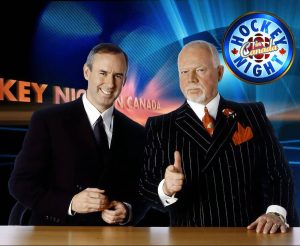
The CBC began broadcasting HNIC in 1952 and adapted to changes over the years, although late in some cases (even though some HNIC games were televised in color starting in 1966, the CBC didn’t adapt to a full-color schedule until 1974 – a full eight years after the U.S. broadcast networks’ entire prime-time schedules made the conversion.) In 1995, CBC added a second Saturday night game, making HNIC doubleheaders. Among the talent who appeared included play-by-play announcers Foster Hewitt, Bob Cole, and Jim Hughson, and commentator Don Cherry – where he and Ron MacLean hosted the popular Coach’s Corner segments during the first intermission.
The changing economics of television meant CBC couldn’t afford to produce and air games – especially as a public broadcaster. Almost similar to what CBS is currently doing with Byron Allen programming the network’s late-night schedule, CBC agreed to let Rogers sublicense HNIC on the network, with Rogers keeping all the ad revenue in exchange for on-air promotion of CBC shows (Schitt’s Creek comes to mind, of course.) Initially for four years, Rogers and CBC gradually extended it for the entirety of the deal.
Canada isn’t immune to the current changes in the television ecosystem, as they are happening globally. Just like in the U.S., linear television broadcasting is in decline – especially over-the-air broadcasting as more and more viewers are ditching pay TV for streaming – something I’ve been saying in this space for the last eight or nine years. But what makes this so puzzling is the NHL and Rogers are doubling and tripling and quadrupling down on cable TV in the Year Of Our Lord 2026 – similar to what the Bulls, Blackhawks, and White Sox did two years ago when the Chicago Sports Network launched at a time with the regional sports network was in decline. What Rogers is doing is really backward, and doesn’t benefit fans at all as they are saddled with an expensive cable subscription to watch the country’s most popular sport.
And out of all of this ironically, is the NHL currently does not have a streaming deal for any of its games in Canada for next season. Its most recent deal with Amazon Prime expired this season after just two years, games that Rogers originally had rights to and gave up. Also unresolved is the rights to French-language Montreal Canadiens telecasts, which were shared between cable networks TVA Sports and RDS.
Here in the States, NHL rights are split between ESPN/ABC and TNT, with their deal expiring after the 2027-28 season, and the league is in discussions with both parties to extended their deals – especially with Paramount soon to take over TNT parent Warner Bros., which could lead to some NHL games landing on CBS – something the network hasn’t aired since 1980.
That’s a real shame, it was such a big part of Saturday nights for so many of us. It’s going to be strange not seeing it on CBC anymore.